
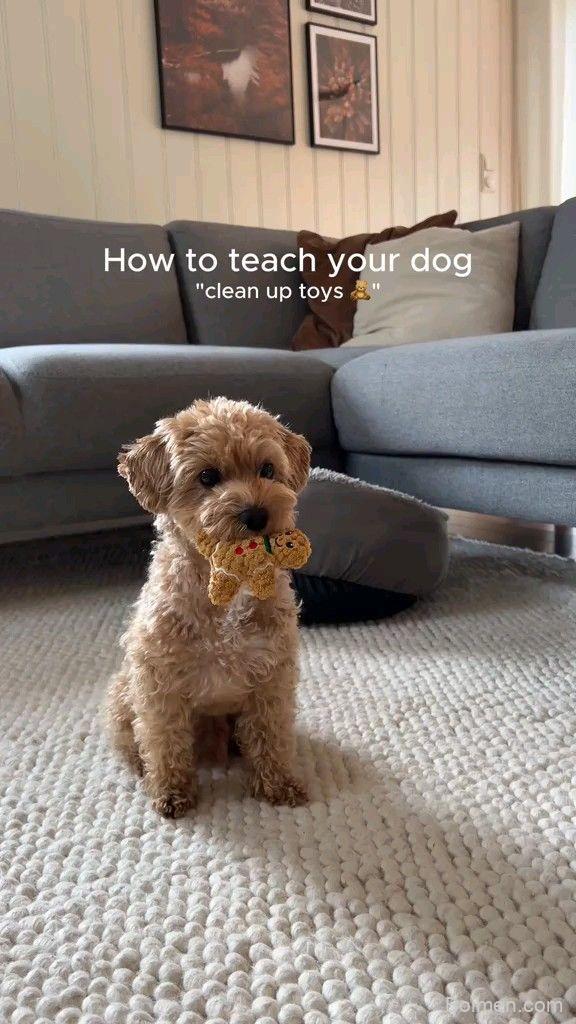
You can teach your dog to put their toys away in about 10 minutes a day—and it's genuinely useful. This guide gives you a concrete plan, from choosing the right toy basket to proofing the behavior in real life.
Advertisements1
- Train in 3–5 minute sessions, 2–3 times a day—short and frequent beats long and frustrating.
- Mark and reward within 2 seconds of the behavior, or you're rewarding the wrong thing.
- Use a low, wide basket to start; upgrade to a taller one only after the behavior is solid.
- Say the cue 'clean up' only once. Repeating it teaches your dog to ignore the first few.
- Generalize to different rooms and toys for at least a week—most people quit too early.
- Switch to a variable reward schedule after 2 weeks to make the behavior stick.
Why 'Clean Up' Is Worth Teaching (Beyond the Cute Factor)
Teaching your dog to clean up toys isn't just a party trick—it builds impulse control, strengthens your bond, and gives your dog a job. Dogs thrive when they have clear tasks. In fact, a 2019 study in Animal Cognition found that dogs are more likely to persist at a task when they receive consistent, positive reinforcement. That's exactly what this training delivers.
There's also a practical payoff: you stop stepping on squeaky toys at 6 a.m. And for high-energy breeds like Border Collies or Australian Shepherds, 'clean up' becomes a mini job that tires their brain. A 5-minute training session can be as enriching as a 20-minute walk for some dogs.
But here's the thing: most people teach this backward. They point at toys, say 'clean up,' and expect the dog to understand. Instead, you'll break it into micro-steps and use a technique called shaping. That's the difference between frustration and a dog who eagerly tidies up.
Prep Time, Session Length, and What You'll Need
Prep time: 2 minutes. Training session: 3–5 minutes, 2–3 times a day. That's it. Short, frequent sessions beat one long one—dogs learn best in bursts, and you'll both stay fresh.
Ingredients (in easy-to-find order):
– 5–10 of your dog's favorite toys (soft, easy to grab)
– 1 low-sided basket or box (a cat litter pan works great)
– High-value treats (freeze-dried liver, boiled chicken, or string cheese)
– A clicker (optional but helpful)
– A quiet space with minimal distractions
Substitutions: If your dog is toy-obsessed, use boring toys like rolled-up socks. If they're food-motivated, use kibble. If they're not food-motivated, use a tug toy as the reward. Improvise based on what your dog loves.
A note on basket choice: a tall laundry basket is a rookie mistake. Your dog needs to see the bottom and drop the toy in easily. Start with a low, wide container and graduate to a taller basket later.
The 3-Phase Method: Shape, Name, Generalize
Phase 1: Shape the drop. Sit on the floor with your dog and the basket. Hold a toy, let them take it, then hover your hand over the basket. The moment they drop the toy near or in the basket, mark with 'Yes!' and treat. Repeat 5–10 times. If they miss, no big deal—just reset. Within a few sessions, most dogs start dropping the toy toward the basket.
Phase 2: Add the cue. Once your dog is reliably dropping the toy into the basket, say 'clean up' just before they drop it. Then reward. After 10–15 repetitions, say 'clean up' and wait. If they pick up a toy and drop it in, jackpot! Give 3–5 treats in a row. That's how you build a strong association.
Phase 3: Generalize. Move the basket to a different room. Use different toys. Ask your dog to clean up when you're standing instead of sitting. This phase is where most people quit too early—but it's the difference between a dog who performs in the living room and one who performs anywhere. Spend at least a week here.
Troubleshooting: If your dog starts grabbing toys and running away, you've likely rewarded too late or too little. Go back to Phase 1 for a day. If they're bored, use higher-value treats or shorten sessions.
Timing and Rewards: The 2-Second Rule
Dogs live in the moment. If you mark and reward more than 2 seconds after the behavior, you're rewarding something else—like standing there or looking at you. That's why a clicker or a quick 'Yes!' is so powerful: it bridges the gap between action and treat.
Here's the exact sequence: dog drops toy in basket → click or say 'Yes!' → treat within 1–2 seconds. If you're fumbling with treats, pre-load your pocket or use a treat pouch. Speed matters more than treat size.
Reward placement also matters. Toss the treat into the basket so your dog associates the basket with good things. This also resets them to look at the basket for the next repetition. It's a subtle but powerful trick.
And don't be stingy. During the learning phase, reward every single successful drop. Once the behavior is solid (after about 2 weeks), switch to a variable schedule: reward every 2nd or 3rd toy. This makes the behavior resistant to extinction—your dog keeps trying because they never know when the jackpot comes.
Common Mistakes (and How to Fix Them)
Mistake #1: Repeating the cue. If you say 'clean up, clean up, clean up,' your dog learns that the first three don't matter. Say it once, wait 3 seconds, then help if needed. Help means guiding them gently, not doing it for them.
Mistake #2: Training when your dog is exhausted or over-aroused. A tired dog won't learn; an over-aroused dog can't focus. Train after a walk or a nap, when your dog is calm but alert.
Mistake #3: Using the same toy every time. Your dog will learn to clean up that one toy and nothing else. Rotate toys every session. Start with 3 different toys in one session once they understand the game.
Mistake #4: Expecting perfection in a week. This is a complex behavior chain: pick up, carry, drop, release. Most dogs need 2–4 weeks of daily practice to generalize. Be patient and keep sessions fun. If you're frustrated, stop and play tug instead.
Mistake #5: Forgetting to phase out treats. You don't have to eliminate treats, but you should move to a variable schedule. Otherwise, your dog may refuse to work for free. Keep a few treats on hand for random jackpots.
Real-Life Example: From Chaos to Clean in 18 Days
When I adopted Biscuit, a 2-year-old terrier mix, his toy bin looked like a tornado hit it. We started with 3-minute sessions twice a day. Day 1: he'd drop a toy if I held it over the basket. Day 4: he dropped it on his own. Day 7: I added the cue 'clean up' and he did it 4 out of 5 times. Day 12: we moved to the living room with 5 toys. Day 18: I said 'clean up' from the kitchen and he cleared all 5 toys in under a minute.
The key? I kept sessions short, rewarded every success, and never repeated the cue. I also used a low basket—a $3 dishpan from Walmart. By week 3, he was offering the behavior without a cue, hoping for a treat. That's when I knew it was solid.
Your dog might take longer or shorter. That's fine. The timeline isn't the point—the consistency is. Two short sessions a day will get you there faster than one long, frustrating one.
Advanced: Chain Multiple Toys and Add Distance
Once your dog reliably cleans up one toy, it's time to chain. Place 3 toys on the floor and ask for 'clean up.' Reward after each toy goes in the basket. Then reward after 2 toys, then after all 3. This builds a behavior chain—your dog learns that the job isn't done until the basket is full.
Next, add distance. Stand 3 feet from the basket. Then 6 feet. Then 10. If your dog breaks down, go back to the last successful distance and practice there for a few reps. This is called 'loose leash' training for distance work—no, just kidding, it's called gradual increase in criteria. But the principle is the same: small steps, high success rate.
Finally, add a release cue. After the last toy goes in, say 'all done' and give a big reward. This tells your dog when the job is finished, so they don't keep searching for toys. It also prevents them from unloading the basket to start over—a common problem if you reward too much after the final drop.
How to Do It, Step by Step
- 1Start with a low basket and high-value treats
Use a wide, low container so your dog can easily drop the toy in. High-value treats (chicken, cheese) make the game worth playing. Why: success rate drives motivation. - 2Shape the drop with no cue
Hold a toy over the basket and wait. The instant your dog drops it in, mark with 'Yes!' and treat. Why: you're building the action before adding a word. - 3Add the cue 'clean up' once the drop is reliable
Say 'clean up' just before your dog drops the toy. After 10–15 reps, say it and wait. Why: this attaches the word to the action. - 4Reward every success during learning
Treat every single drop for the first 2 weeks. Then switch to every 2nd or 3rd toy. Why: variable rewards make the behavior stronger long-term. - 5Generalize to different rooms and toys
Practice in the living room, bedroom, and yard. Use different toys each session. Why: dogs don't automatically generalize—they need variety. - 6Chain multiple toys and add distance
Place 3 toys down and reward after each, then after all 3. Gradually stand farther away. Why: this turns a single trick into a full clean-up routine. - 7Add a release cue like 'all done'
After the last toy, say 'all done' and give a jackpot reward. Why: it tells your dog when the job is finished and prevents them from unpacking the basket.
The secret to teaching clean up isn't the cue—it's the timing. Reward within two seconds, and your dog will learn faster than you thought possible.
Frequently Asked Questions
How long does it take to teach a dog to clean up toys?
Most dogs learn the basic drop in 3–7 days with two short sessions daily. Full generalization to different rooms and multiple toys takes 2–4 weeks. Consistency matters more than speed.
What if my dog just runs away with the toy?
That usually means you're rewarding too late or the toy is more valuable than the treat. Go back to shaping with a low basket and higher-value treats, and reward the moment the toy leaves their mouth near the basket.
Can I teach an older dog to clean up?
Absolutely. Older dogs can learn new tricks—they often have better focus than puppies. Adjust session length to 2–3 minutes and use extra-tasty treats. The method is the same.
Do I need a clicker to teach this?
No, a verbal marker like 'Yes!' works fine. A clicker can be more precise, but it's not necessary. What matters is marking the exact moment the toy goes in the basket.
How do I get my dog to clean up all their toys, not just one?
Chain the behavior by placing multiple toys down and rewarding after each one goes in. Gradually increase the number of toys and reward after 2, then 3, then all of them. Add a release cue like 'all done' to signal the end.

Elena focuses on healthy cooking and meal prep for people with limited time and budget. She shares flexible recipes and shortcuts that don’t sacrifice flavor.


Leave a Comment