
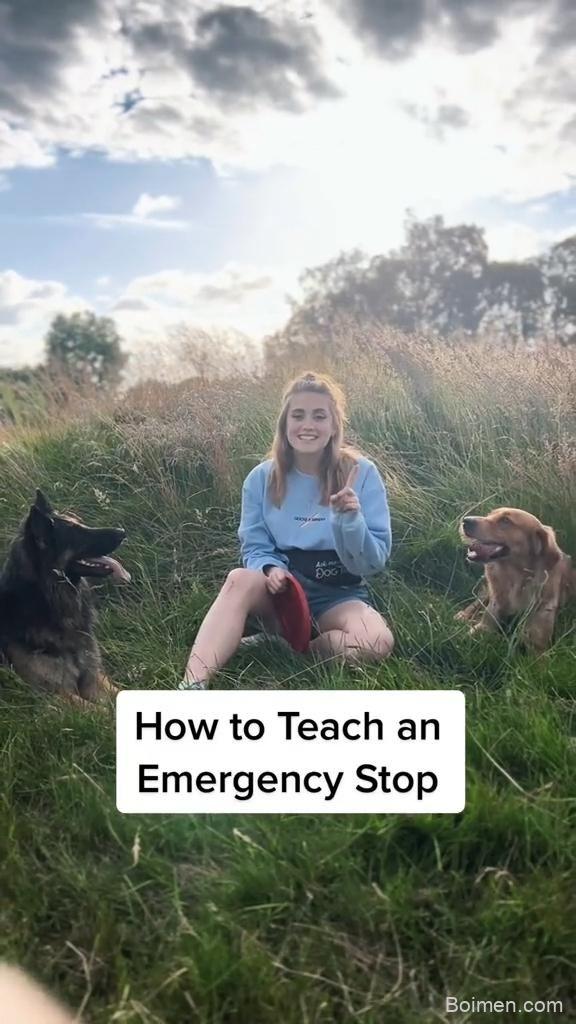
A reliable emergency stop can save your dog's life. In this guide, I'll show you how to train a rock-solid stop using positive reinforcement, with clear steps and real-world numbers.
Advertisements1
- A reliable emergency stop can prevent accidents; train it with positive reinforcement and high-value rewards.
- Use a marker (clicker or 'yes') to precisely reward the stop behavior; timing within 1 second is critical.
- Proof the stop against distance, duration, and distraction; aim for 80% success at each level before progressing.
- Never repeat the cue; say 'stop' once and enforce if necessary to maintain its power.
- Keep training sessions short (under 5 minutes) and frequent (3 per day) for best results.
- Always carry a long line as backup; no cue is 100% reliable in high-risk situations.
Why Every Dog Needs an Emergency Stop
An emergency stop is a trained behavior where your dog immediately halts and holds position on a single cue, regardless of distractions. Unlike a basic 'sit' or 'down,' this cue must override your dog's drive to chase, greet, or explore. I've seen dogs bolt toward traffic, and the difference between a near-miss and a tragedy often comes down to one well-proofed cue.
Consider the math: a dog running at 20 mph covers 29.3 feet per second. If your dog is 30 feet away and you spot a car 100 feet away moving at 30 mph (44 feet per second), you have roughly 2.3 seconds before impact. A dog trained to stop in under 1 second can be recalled or stopped in time; one that takes 3 seconds cannot. That's why we train for instant, reflexive responses.
This isn't about dominance or punishment. It's about building a conditioned response through positive reinforcement, so your dog chooses to stop because it's the most rewarding option. The result is a dog that's safer and more reliable off-leash.
The Foundation: Marker Training and High-Value Rewards
Before you teach the stop, you need a way to communicate precisely when your dog does the right thing. I use a clicker or a verbal marker like 'yes' (charged beforehand). Pair the marker with high-value food: boiled chicken, cheese, or freeze-dried liver. Kibble won't cut it when you're competing with a squirrel.
Start by charging the marker: click, then treat. Repeat 20 times in a low-distraction room. Your dog should perk up at the click. Next, reward position changes. When your dog naturally sits, click and treat. Do 10 reps, then take a break. This builds value for the sit without luring or pushing.
Sample calculation: If you train 3 sessions per day, 5 minutes each, with 10 rewards per minute, that's 150 rewards daily. Over a week, that's 1,050 repetitions—enough to start building fluency. But quality matters more than quantity. Each reward must be timed within 1 second of the behavior.
Teaching the Stop: Shaping a Standing Halt
I prefer a standing stop over a sit because it's faster to achieve and easier to hold under excitement. Here's how: with your dog on a 6-foot leash in a quiet space, walk backward and encourage your dog to follow. When your dog is moving toward you, say 'stop' in a firm, cheerful tone, then immediately stop moving and freeze. Your dog will likely pause. Mark and reward the pause.
Repeat this 10 times, then add distance. Move to a 15-foot leash or long line. Say 'stop' as your dog moves toward you, then stand still. If your dog stops, mark and reward. If not, you're moving too fast or the reward isn't high enough. I aim for 80% success rate before increasing difficulty. If you're below 80%, reduce distractions or distance.
After 20-30 repetitions, your dog will start anticipating the stop when you say the cue. That's when you add a hand signal: palm facing your dog, like a traffic cop. Use both verbal and visual cues for reliability. Once your dog stops consistently on a long line, you can fade the leash.
Proofing the Stop: Adding Distance, Duration, and Distraction
A stop that works in your living room won't work at the park. You need to proof it against the three Ds: distance, duration, and distraction. Start with distance: practice on a 30-foot long line in a quiet park. Say 'stop' when your dog is 10 feet away, then 20, then 30. Reward every correct response. If your dog fails, you've jumped too far—go back 5 feet and rebuild.
Duration: once your dog stops, ask for a 2-second hold before rewarding. Gradually increase to 5, then 10 seconds. Use a release word like 'free' to end the behavior. I use a stopwatch to track holds. A 10-second hold under distraction is a solid goal for most pet dogs.
Distraction: introduce triggers like other dogs, squirrels, or moving cars at a distance where your dog notices but doesn't react. Say 'stop' and reward heavily for compliance. If your dog breaks, you're too close. I use a 10-foot rule: start 10 feet farther away than where your dog first notices the trigger. Over 4-6 weeks, you can close that gap. Always end on a success.
Common Mistakes and How to Fix Them
Mistake #1: Repeating the cue. If you say 'stop, stop, stop,' your dog learns the first cue is meaningless. Say it once, then enforce if needed (e.g., step on the long line). I see this in 90% of owners who struggle.
Mistake #2: Using the stop as punishment. If you call your dog to stop and then leash them to go home, they'll associate the stop with ending fun. Instead, stop, reward, then release back to play. I do 3 stops for every 1 recall to keep it positive.
Mistake #3: Training when you're frustrated. Dogs read your tone and body language. If you're tense, they'll be less likely to respond. Keep sessions under 5 minutes and end before you or your dog gets bored. Track your sessions: aim for 3 per day, 5 days a week. That's 15 sessions weekly, or 60 per month. Progress may feel slow, but consistency beats intensity.
Real-World Application: When and How to Use the Stop
The emergency stop is not a replacement for a recall or a leave-it. It's a last line of defense. Use it when your dog is about to bolt into danger: an open gate, a busy street, or a aggressive dog. In those moments, a sharp 'stop!' followed by a reward can interrupt the behavior long enough for you to intervene.
I also use it during off-leash hikes when I need my dog to pause while I navigate a tricky section. For example, if we approach a cliff edge, I'll cue 'stop,' reward, then clip the leash. This keeps my dog safe without killing the fun.
Remember: no cue is 100% reliable. Even highly trained dogs can fail under extreme stress. That's why I always carry a 30-foot long line for backup and never rely solely on verbal control in high-risk areas. Train the stop, but also manage the environment.
How to Do It, Step by Step
- 1Charge your marker
Click or say 'yes' then immediately give a high-value treat. Repeat 20 times in a quiet room until your dog visibly anticipates the reward. - 2Reward all sits
When your dog naturally sits, mark and treat. Do 10 reps per session, 3 sessions daily, to build value for the behavior. - 3Introduce the stop cue
With your dog on a 6-foot leash, walk backward, say 'stop' once, then freeze. Mark and reward any pause. Repeat 10 times. - 4Add distance on a long line
Move to a 15-foot long line. Say 'stop' as your dog moves toward you. Reward successful stops. Aim for 80% success before increasing distance. - 5Proof against distractions
Practice in a park with other dogs at a distance. Start 10 feet farther than where your dog notices the trigger. Gradually decrease distance over 4-6 weeks. - 6Practice duration holds
Once your dog stops, ask for a 2-second hold before rewarding. Increase to 5, then 10 seconds. Use a release word like 'free'.
A dog trained to stop in under 1 second can be recalled or stopped in time; one that takes 3 seconds cannot.
Frequently Asked Questions
How long does it take to train an emergency stop?
Most dogs can learn a basic stop in 2-4 weeks with daily practice. Reliable proofing under distractions takes 2-3 months of consistent training.
Can I use the emergency stop with any dog breed?
Yes, any breed can learn an emergency stop, but high-drive breeds like huskies or terriers may require more repetitions and higher-value rewards.
What if my dog ignores the stop cue?
If your dog ignores the cue, you've likely increased difficulty too quickly. Go back to a lower-distraction environment and reward heavily for success. Never punish; it will poison the cue.
Is an emergency stop the same as a recall?
No, a recall asks your dog to come to you, while an emergency stop asks your dog to halt and stay in place. Both are important, but the stop is for immediate danger.
Do I need a clicker to train an emergency stop?
A clicker is helpful but not required. A verbal marker like 'yes' works just as well if charged properly with high-value rewards.

Diego covers personal finance and investing for freelancers and gig workers. His angle is practical money management for irregular income, from budgeting to tax basics.


Leave a Comment