
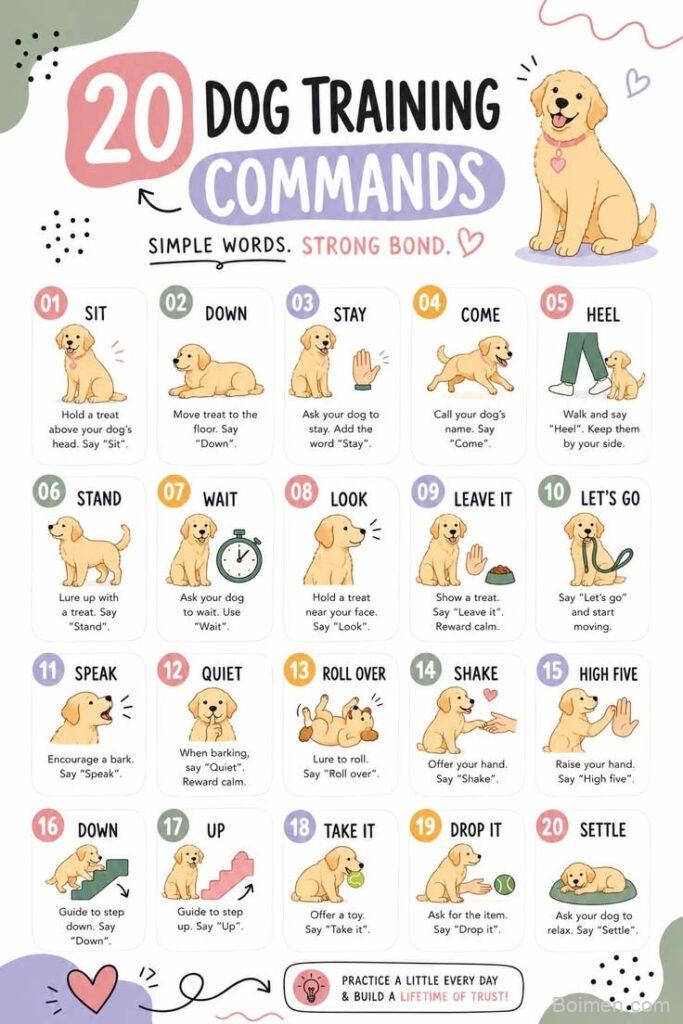
Picture this: you're standing in the kitchen at 7 a.m., and your dog has just performed a flawless interpretive dance of barking, spinning, and sock theft while you tried to answer one email. The good news? None of that means your dog is stubborn — it means your training strategy hasn't caught up with your dog's brain yet. Here are the strategies that actually move the needle, with the do-this-not-that reasoning behind each one.
Advertisements1
- Say each cue once and wait two seconds — repetition teaches your dog to ignore the first three asks.
- Reward the behavior you want within one second; scolding tells your dog what not to do, but never what to do instead.
- Reserve high-value treats for hard tasks only — a dry biscuit won't beat a squirrel.
- Train in 3-5 minute bursts two to three times a day and end on a win.
- Proof every cue through five levels of distraction, moving up only at 8 out of 10 success.
- Track one behavior at a time on a sticky note for two weeks — focus compounds faster than variety.
Start With the Two-Second Rule for Every Command
Most people repeat a cue three or four times before the dog responds — which quietly teaches the dog that the first three asks are background noise. Try this instead: say the cue once, then give your dog a full two seconds of silence to process it. That pause feels enormous to a human and completely normal to a dog.
If nothing happens after two seconds, don't repeat yourself louder. Either make the cue easier (move closer, reduce distractions) or gently guide the behavior and reward. I've watched clients cut their 'sit' latency from five seconds to under one in a single week simply by stopping the repetition loop.
Think of it like calling someone's name across a room — if you shout it four times, they learn they only need to look up on the fourth. Say it once, and mean it.
Reward the Behavior You Want, Not the One You're Trying to Stop
Here's a trap nearly every dog owner falls into: the dog jumps up, you push them off and say 'no' — and the dog just learned that jumping earns touch and attention. Negative attention is still attention, and for a social animal, attention is currency.
Instead, build a competing behavior. Teach 'four on the floor' (all paws down) and reward it within one second of it happening, every single time, for two weeks. Keep treats in a bowl by the door so the reward is instant. A 2021-style training principle still holds: behaviors that get reinforced get repeated, and behaviors that get ignored fade.
Don't scold the jump — redirect and pay the calm. It feels passive, but it's dramatically faster than correction. Scolding tells your dog what not to do; rewarding tells them exactly what to do instead.
Use High-Value Rewards Only for Hard Things
If you use the same dry biscuit for 'sit in the living room' and 'come back from a squirrel at the park', you're asking a dog to choose a cracker over a chase. Match the reward to the difficulty. Easy behavior in a quiet room? Kibble or praise is fine. Recall in a distracting environment, or a first-ever nail trim? Bring out real cheese, freeze-dried liver, or a squeaky toy your dog only sees during training.
I keep a 'jackpot jar' in the fridge — small cubes of cheddar — reserved exclusively for recalls and vet-handling practice. That exclusivity is the whole point. When the cheese only appears for the hardest tasks, your dog starts paying attention the moment the jar opens.
Do this, not that: don't feed your dog's entire dinner from a bowl and then wonder why training treats lose their power. Reserve 20-30% of daily calories for training and use the bowl for the rest.
Train in Three-to-Five Minute Bursts, Not Marathon Sessions
Dogs — especially puppies and adolescents — have a working attention span measured in minutes, not hours. Three to five minutes of focused, high-rate reinforcement beats a 30-minute session every time. Short sessions also let you end on a win, which keeps your dog eager for the next round.
Aim for two to three micro-sessions a day, and attach them to things you already do: before meals, before the leash goes on, after a potty break. This is called 'capturing' and 'tethering' in training circles — you're borrowing the momentum of an existing routine.
Metaphor time: you wouldn't learn guitar by playing for two hours once a week. Ten minutes a day, every day, and suddenly you're playing songs. Dogs learn the same way.
Proof the Cue in Five Distractions Before You Trust It
A 'sit' that works in your kitchen is not a 'sit' — it's a party trick. Real reliability comes from proofing: practicing the same cue in gradually harder environments. I use a simple ladder: (1) quiet room, (2) living room with TV on, (3) backyard, (4) front yard on leash, (5) park at a distance from other dogs.
Only move up a rung when your dog succeeds 8 out of 10 tries at the current level. If they fail twice in a row, drop back down a rung — that's not failure, that's data. Most 'stubborn' dogs are simply being asked to perform at a level they never actually mastered.
Don't jump from kitchen to dog park and conclude your dog 'forgot everything'. You skipped four rungs. Build the ladder, and the top will hold.
Give Your Dog a Job: Enrichment Is Training's Quiet Partner
A dog who has spent the day staring at a wall has a brain full of unspent energy, and that energy comes out as barking, chewing, or 'selective hearing'. Before you blame the training, check the enrichment. Twenty minutes of sniffing on a decompression walk can do more for behavior than an hour of drilling cues.
Practical options: scatter feeding in the grass, a snuffle mat, frozen stuffed toys, or a simple 'find it' game where you hide kibble around one room. These aren't just cute — they're genuine cognitive work that lowers arousal and makes formal training sessions far more productive.
Do this, not that: don't replace a walk with a treadmill of fetch. Sniffing is the dog equivalent of reading a good novel — it's how they process their world.
Track One Behavior at a Time (Yes, With a Sticky Note)
Here's the unglamorous secret: the people whose dogs improve fastest are the ones who write things down. Pick exactly one behavior per two-week block — say, 'settles on a mat while I cook' — and track it on a sticky note on the fridge with a simple tally of successes and misses.
Why one behavior? Because splitting your attention across five cues means none of them get the consistent, high-rate reinforcement that drives learning. Focus compounds. I've seen owners fix leash pulling in three weeks by ignoring everything else and only rewarding a loose leash.
At the end of two weeks, look at the tally. If the line is going up, keep going. If it's flat, the criteria are too hard — make it easier. That's it. That's the whole system.
How to Do It, Step by Step
- 1Pick one cue and one behavior for the next 14 days
Write it on a sticky note and put it on the fridge. Focusing on a single behavior means every repetition gets your full attention and consistent reinforcement, which is what actually builds reliability. - 2Set up a jackpot jar in the fridge
Fill a small container with a high-value treat (cheddar cubes, freeze-dried liver) used only for hard tasks like recall. Exclusivity makes the reward powerful when it matters. - 3Say each cue exactly once, then wait two seconds
Give your dog processing time instead of repeating the command. If nothing happens, make the task easier or guide the behavior, then reward. - 4Run two to three micro-sessions of 3-5 minutes daily
Attach them to existing routines — before meals, before walks. Short sessions keep reinforcement rates high and end on a win. - 5Reward within one second of the behavior
Keep treats within arm's reach so timing stays tight. A reward delivered three seconds late reinforces whatever the dog was doing at that moment. - 6Build a five-rung distraction ladder
Practice in a quiet room, then with TV on, then backyard, then front yard, then park at a distance. Move up only at 8/10 success; drop back after two failures. - 7Add 20 minutes of sniffing or enrichment daily
Scatter feeding, snuffle mats, or a 'find it' game burns mental energy and lowers arousal, making formal training sessions noticeably more productive. - 8Review your sticky-note tally every two weeks
If successes are rising, keep the criteria. If flat, make the task easier. Adjust based on data, not frustration.
Most 'stubborn' dogs aren't stubborn at all — they're being asked to perform at a level they never actually mastered.
Frequently Asked Questions
How long does it take to train a dog basic commands?
Most dogs can learn a basic cue like 'sit' in three to five short sessions, but reliable, distraction-proof performance typically takes four to eight weeks of daily practice. Consistency matters far more than session length.
Should I use treats every time I train my dog?
Yes during the learning phase — reward every correct response for the first couple of weeks. Once the behavior is solid, transition to intermittent reinforcement (roughly every second or third success) to make the behavior durable.
Why does my dog ignore me when we're outside?
Almost always because the cue was never proofed beyond the living room. Practice in gradually harder environments and move up only when your dog succeeds eight out of ten times at the current level.
Is it bad to repeat commands to my dog?
Repeating cues teaches your dog that the first several asks are optional. Say it once, pause for two seconds, then make the task easier or guide the behavior rather than repeating yourself.
How much exercise does a dog need for good behavior?
Physical exercise varies by breed, but mental enrichment — 20 minutes of sniffing, scatter feeding, or puzzle toys — often reduces unwanted behavior more effectively than extra miles of running.

Priya explores creative writing prompts and storytelling techniques for aspiring authors. She shares exercises to spark imagination and build narrative confidence, drawn from her own writing practice.


Leave a Comment