
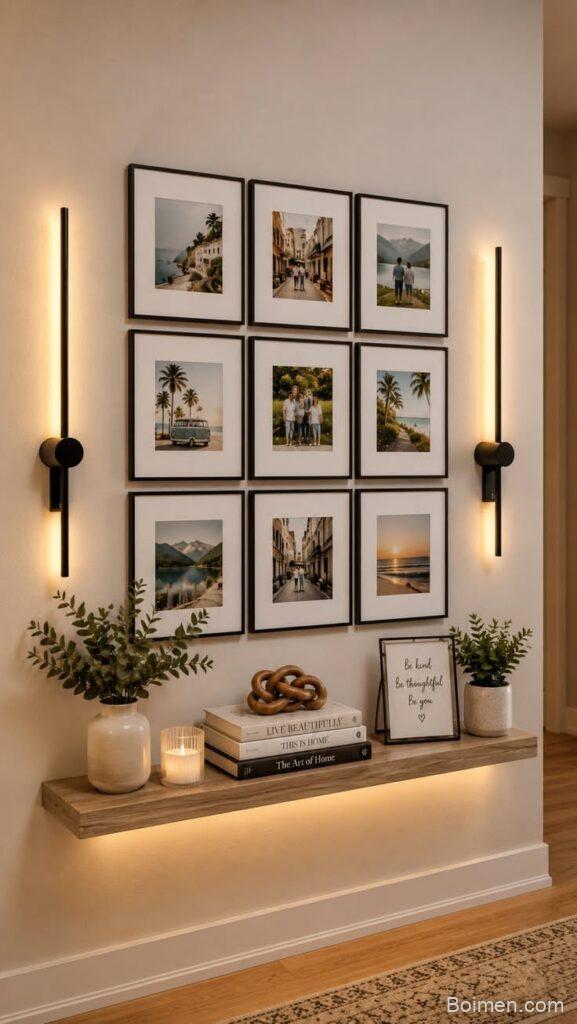
An empty corner is the cheapest square footage in your home — and the hardest to use. Most people either leave it bare or shove a floor lamp into it and call it done. The problem is structural: corners have two walls, awkward sightlines, and no obvious center point, so standard gallery-wall math falls apart.
Advertisements1
Quick win: before you buy anything, stand in the corner and photograph it from three angles — doorway, sofa, and hallway. You will instantly see which wall reads as the “main” one. That single photo decides your layout, and it takes ninety seconds.
What follows is a working list of layout systems, print sources, and mounting hardware that actually solve the corner problem. Each entry is judged on one thing: does it make a tight, angled space look intentional?
Table of Contents(Click to Toggle)
Why Corner Walls Are the Most Underused Space in Your Home
Corner walls fail for a predictable reason: they have no natural focal point. A flat wall gives you a center. A corner gives you a seam, and a seam forces you to choose a direction.
There are only three honest ways to handle it. You can wrap the arrangement around the seam so the corner becomes the subject. You can anchor one wall and let the other stay quiet. Or you can stack vertically and treat the corner as a column.
Each approach has trade-offs:
- Wrap-around: strongest visual impact, but requires precise spacing and matching frame depths.
- Single-wall anchor: easiest to execute, but can look lopsided if the adjacent wall stays completely bare.
- Vertical stack: ideal for narrow corners and stairways, but demands consistent widths.
The tools and sources below are organized around those three systems, not around brand hype. Prices shift constantly, so treat any figure here as a rough benchmark rather than a quote.
Corner Wall Gallery Ideas and Tools
1. Desenio : The fastest way to build a matched corner grid
What it is: A Scandinavian poster and frame retailer with pre-built gallery wall sets.
Category: Prints and frames
Why it stands out:
- Their curated “gallery wall” bundles ship with a downloadable layout guide showing exact spacing.
- Frame profiles are consistent across sizes, which matters enormously in a corner where two walls sit side by side and mismatched depths become obvious.
- Frequent multi-buy pricing means a six-piece corner grid costs noticeably less than assembling it piecemeal.
Best for: Anyone who wants a finished corner in one order without measuring five different frame styles.
2. Society6 : Independent art with unusual proportions
What it is: A marketplace where independent artists sell prints, canvases, and framed work.
Category: Artist marketplace
Why it stands out:
- Carries tall, narrow formats that fill vertical corner gaps better than standard 18×24 prints.
- You can filter by orientation, which saves time when you need three portrait pieces for a stacked corner column.
- Artist-direct pricing keeps mid-size prints reasonable, though shipping times vary by artist and can stretch past two weeks.
Best for: Corners that need one strange, specific shape nothing else fits.
3. Minted : Limited-edition prints with framing included
What it is: A design marketplace offering limited-edition art, custom framing, and photo products.
Category: Curated marketplace
Why it stands out:
- Limited-edition runs mean your corner print is unlikely to appear in a neighbor’s hallway.
- Their framing tool previews mat width and frame color against your uploaded wall photo, which reduces the guesswork on corner color clashes.
- Pricing sits above mass retailers, so it works best when you are buying one statement piece rather than eight filler prints.
Best for: A single hero piece anchoring one wall of the corner.
4. Framebridge : Custom framing for art you already own
What it is: A mail-in and online custom framing service.
Category: Custom framing
Why it stands out:
- Useful when your corner plan mixes thrifted art, family photos, and travel prints that all need a unified frame.
- You can order matching frames across wildly different artwork sizes, which is the single biggest visual fix for an awkward corner.
- Turnaround typically runs one to two weeks, so plan ahead if you are styling for a specific date.
Best for: Unifying a mismatched collection into one coherent corner.
5. Etsy : Downloadable prints for instant corner grids
What it is: A global marketplace including thousands of digital print shops.
Category: Digital downloads
Why it stands out:
- Instant-download listings let you print at any size, so you can scale a set to fit an exact corner measurement.
- Many sellers bundle ten or more coordinating prints, which is ideal for a dense wrap-around grid.
- The catch: you handle printing and framing yourself, and quality depends entirely on the specific shop.
Best for: Budget-conscious planners who do not mind a print-shop errand.
6. IKEA : Cheap, uniform frames for large grids
What it is: The global furniture retailer’s frame and print range.
Category: Frames and budget prints
Why it stands out:
- Their basic frames come in consistent sizes and colors, which is exactly what a twelve-piece corner grid needs.
- Because they are inexpensive, you can buy one extra as a spacing template before committing to the full layout.
- The trade-off is limited size range and plastic glazing on the cheapest options, which reflects light differently than glass.
Best for: Big, dense grids where frame cost would otherwise explode.
7. Saatchi Art : Original work for a single statement corner
What it is: An online gallery selling original paintings, drawings, and sculpture.
Category: Original art
Why it stands out:
- If your corner plan is one large piece rather than a grid, originals carry weight that prints cannot replicate.
- You can filter by size and price, which keeps the search grounded when you have a fixed wall width.
- Shipping and customs vary by artist location, so confirm timelines before buying for a deadline.
Best for: A single oversized anchor piece in a living room corner.
8. Juniper Print Shop : Vintage-style prints that suit warm corners
What it is: A small print studio known for muted, vintage-inspired artwork.
Category: Niche print studio
Why it stands out:
- The palette is deliberately soft, which prevents a corner from feeling visually loud in a small room.
- Prints are designed to layer together, so a three-piece corner cluster looks intentional rather than random.
- Catalog size is modest compared to marketplaces, so it is a quick browse rather than an endless scroll.
Best for: Bedroom and hallway corners that need calm, not contrast.
9. 20×200 : Affordable editions from working artists
What it is: A print publisher offering limited editions at multiple price tiers.
Category: Edition publisher
Why it stands out:
- Each artwork is released in several sizes, so you can buy small for a stairway corner and large for an office corner from the same series.
- Editions are numbered, which adds a sense of permanence without gallery pricing.
- Smaller sizes sell out faster, so check availability before planning a specific grid.
Best for: Mixing two sizes of one artwork across a corner seam.
10. Art.com : The widest catalog for matching a specific color
What it is: A large online art and poster retailer with framing options.
Category: Mass art retail
Why it stands out:
- Search filters by color, subject, and orientation make it easy to find three prints that echo an existing rug or cushion.
- Framing is available at checkout, which shortens the total project timeline.
- The catalog is enormous, so the real skill is narrowing rather than browsing.
Best for: Color-matching a corner to an existing room palette.
11. Command Brand : Damage-free hanging for rental corners
What it is: Removable adhesive strips and hooks for hanging without nails.
Category: Hanging hardware
Why it stands out:
- Solves the rental problem entirely — no holes, no patching, no deposit dispute.
- Their picture-hanging strips are rated by weight, so check the number before trusting a heavy framed piece to adhesive.
- Works best on smooth, painted surfaces; textured wallpaper and fresh paint are known weak points.
Best for: Renters and anyone who rearranges often.
12. Artifact Uprising : Photo grids with a consistent look
What it is: A photo print and framing company focused on minimal design.
Category: Photo printing
Why it stands out:
- Their square and standard formats line up neatly in a corner grid, which is harder than it sounds with mixed photo sizes.
- Paper and frame finishes are consistent, so a family photo corner looks like one project instead of a decade of accumulation.
- Pricing is premium, so it suits a small, deliberate grid rather than a wall-filling one.
Best for: Family photo corners in bedrooms and stairways.
13. Mixtiles : Repositionable tiles for experimenting
What it is: Lightweight photo tiles that stick to the wall and can be repositioned.
Category: Photo tiles
Why it stands out:
- Because tiles peel and restick, you can test a corner arrangement physically instead of guessing on paper.
- No frame needed, which keeps a dense grid light and visually quiet.
- They are best on smooth walls, and the tile format limits you to square or near-square crops.
Best for: Anyone who wants to rearrange a corner grid monthly.
14. Opposite Wall : Minimal frames with a strong grid aesthetic
What it is: A print and frame brand built around clean, modern layouts.
Category: Prints and frames
Why it stands out:
- Their frame profiles are thin, which keeps a corner from feeling boxed in.
- Curated sets are grouped by layout style, so you can copy a proven arrangement rather than invent one.
- Shipping regions vary, so confirm availability before planning around a specific set.
Best for: Modern minimalist corners in home offices.
15. Poster Store : Budget grids with matching frames
What it is: A poster retailer offering prints and coordinated frames.
Category: Budget prints
Why it stands out:
- Low unit pricing makes a nine-piece corner grid realistic on a small budget.
- Frames are sold in matching sets, which removes the depth-mismatch problem entirely.
- Paper quality is entry-level, so these work best as decorative fillers rather than heirloom pieces.
Best for: Large grids in hallways and stairways.
16. Lumas : Fine-art photography for gallery corners
What it is: A photography-focused art publisher with limited editions.
Category: Fine-art photography
Why it stands out:
- If your corner is a single large photograph, this is where the tonal range and print quality justify the price.
- Editions are limited and come with certificates, which matters if the piece is a long-term purchase.
- Prices are firmly in investment territory, so it is not a grid-filler source.
Best for: One museum-grade piece in a living room corner.
17. Google Arts & Culture : Free reference for planning layouts
What it is: A free digital archive of artworks and museum collections.
Category: Reference and inspiration
Why it stands out:
- Use it to study how museums hang works around corners and in alcoves — the spacing logic transfers directly to a home.
- High-resolution images let you zoom into frame proportions and mat widths before you buy anything.
- It is a planning tool, not a store, so pair it with one of the print sources above.
Best for: Deciding your layout before spending a cent.
Bonus Mentions
Local print shops : Cheapest route for large-format corner prints
Independent print shops handle oversized formats that home printers cannot, and you can inspect paper stock in person before committing.
Mirror alternatives : A single round mirror as a corner anchor
In narrow corners, one round mirror does more than five prints — it bounces light and softens the hard 90-degree angle.
Corner shelving : Mixing objects with wall art
A slim corner shelf under a small print cluster adds depth and gives the arrangement a base to sit on.
Laser level : The tool that fixes crooked corner grids
A self-leveling laser line removes the single most common reason gallery walls look amateur — uneven horizontal alignment.
Paper templates : Test the layout before drilling
Cut paper to each frame’s exact size and tape the arrangement to the wall for a day. If it looks wrong at eye level, it is wrong.
The Corner You Keep Avoiding Is the One People Notice
Corners are not a decorating afterthought — they are the edges of a room, and edges are what the eye uses to judge whether a space feels finished. The fix rarely requires a bigger budget. It requires a decision about which of the three systems you are using, and then consistency.
Pick your system, pick one source for frames so depths match, and use a laser line so the grid reads as deliberate. That is the whole method.
Which corner in your home have you been quietly avoiding — and what is actually stopping you from starting it this weekend?
Stay focused, stay light.

Kenji covers tech productivity and digital minimalism for remote workers. He writes about streamlining workflows and cutting digital clutter with a focus on mental clarity, not just efficiency.


Leave a Comment