
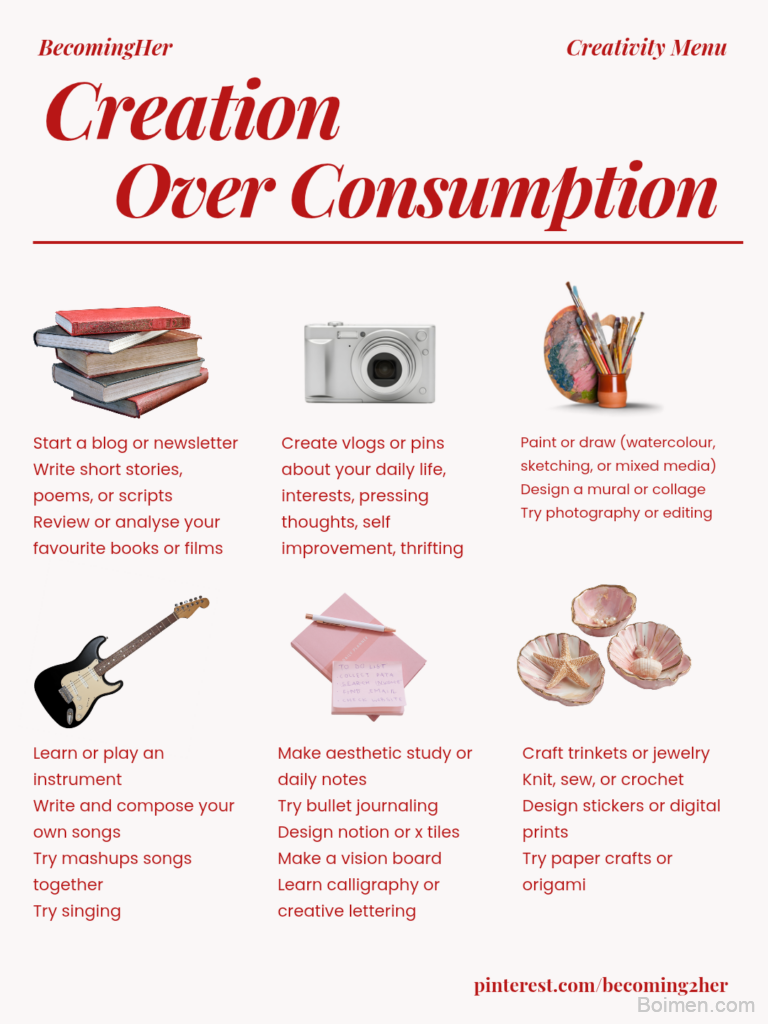
Imagine walking into your favorite café, but instead of a chalkboard menu, there's a blank wall. That's how your brain feels when you stare at a blank page. Let's build your creativity menu—a customizable list of prompts, constraints, and playful challenges that turn 'I have no ideas' into 'I have too many.'
Advertisements1
- A creativity menu is a curated list of prompts that saves you from the blank page paralysis.
- The best prompts include a subject, a constraint, a twist, a form, and a time limit.
- Constraints like timers and word limits are your friends—they force creativity.
- Build your menu from your own curiosities, memories, and fears for endless personal material.
- Make it a daily 5-minute ritual, paired with an existing habit like coffee.
- When stuck, use the 'order anything' rule—just pick a prompt and start writing messy.
Why a Creativity Menu Works (and a Blank Page Doesn't)
A blank page is a vacuum—it sucks the confidence right out of you. A creativity menu gives your brain a limited set of options, which paradoxically frees it. When you choose from a list, you're not inventing from nothing; you're remixing. Think of it like a tasting menu at a restaurant: you don't have to decide the whole meal, just pick a few dishes that sound intriguing.
In my own writing practice, I've found that having a menu of 10-15 prompts cuts my 'starting time' from 45 minutes to under 5. It's the difference between wandering a huge supermarket and picking from a curated box of ingredients. You still cook, but the shopping is done.
The 5-Ingredient Prompt Recipe
Every good creativity prompt is a recipe with five ingredients: a subject, a constraint, a twist, a form, and a time limit. For example, 'Write a haiku about your morning coffee, but from the perspective of the mug, in 10 minutes.' That's specific enough to spark something, but open-ended enough to let you play.
When I teach this to my workshop groups, I see immediate relief. Instead of 'I don't know what to write,' they say 'I can do that.' The constraint is a sandbox, not a cage. It's like giving a child a coloring book with lines—they color inside first, then eventually draw their own.
How to Stock Your Menu with Personal Prompts
Your menu should feel like your favorite playlist—full of songs you love but haven't heard in a while. Start by listing 10 things you're curious about, 10 things you've done that felt effortless, and 10 things you'd love to try but are scared of. Mix and match: 'Write a letter to your 10-year-old self about the time you got lost in a foreign city.'
I keep a 'prompt jar' on my desk—literally slips of paper with phrases like 'the last time I laughed so hard I cried' or 'a secret I've never told.' When I'm stuck, I pull one. It's become a ritual, and it always gets me going.
The Power of Constraints: Time, Word Count, and Tools
Constraints are your friends. A 5-minute timer forces you to write before your inner critic wakes up. A 100-word limit makes you choose every word. Using only one color of pen or a typewriter with no delete key—these sound silly, but they work. I once wrote a whole story using only 50 words, and it was one of the most creative pieces I've produced.
Try this: set a timer for 7 minutes and write a micro-story using exactly 6 words. No more, no less. The constraint forces you to be precise and playful. It's like dancing in a small room—you have to move differently than on a big stage.
Turning Your Menu into a Daily Ritual
Consistency beats intensity. I recommend a daily 'creativity appetizer'—5 minutes, one prompt, no editing. Over a week, that's 35 minutes of pure idea generation. You'll be surprised how many seeds sprout into full projects.
To make it stick, pair it with an existing habit. For me, it's right after I pour my morning coffee. I keep my prompt jar next to the kettle. It's not about discipline; it's about making it easy. You don't need a fancy journal—a scrap of paper works. The key is to do it before you check your phone.
When You're Still Stuck: The 'Order Anything' Rule
Sometimes even the menu feels overwhelming. That's when you use the 'order anything' rule: pick the first prompt your eyes land on, no matter how silly. The point isn't the prompt itself—it's the act of starting. I call it 'throwing a dart at the menu.' You might not want the fried pickles, but once you taste them, you're glad you ordered.
Another trick: change your medium. If you write, try drawing. If you draw, try making a list. The shift in format jolts your brain into a new groove. I once wrote a poem as a grocery list—'loneliness, two for one, aisle 3.' It was bizarre, but it sparked a whole essay.
From Menu to Masterpiece: Turning Sparks into Finished Work
The creativity menu is just the appetizer. Once you have a spark, you need to fan it into a flame. That means giving yourself permission to write a messy first draft. No editing, no judging—just get the words out. I call it 'throwing up on the page,' and I do it every time.
After the mess, you can shape it. Look for the one sentence that surprises you, the image that feels alive. That's your core. Then build around it. I've turned a 6-word story into a 2,000-word essay by asking 'what if?' What if the character didn't say that? What if the setting was different? The menu gives you the start; your curiosity gives you the journey.
How to Do It, Step by Step
- 1Set a timer for 5 minutes
Grab a piece of paper and a pen. A timer creates urgency that bypasses your inner critic. You'll be amazed at what you write when you know you only have 300 seconds. - 2Pick a prompt from your jar or list
Don't overthink it—choose the first one that catches your eye. The goal is to start, not to pick the 'best' prompt. Each one is a door; any door will do. - 3Write without stopping or editing
Let your pen move even if you write 'I don't know what to write' over and over. The act of writing unlocks your brain. You can't edit a blank page, but you can edit a messy one. - 4Read what you wrote and circle one phrase
Find the one image, sentence, or idea that surprises you. That's your gold. It might be buried in the middle, but it's there. Circle it, and let it be the seed for a bigger piece. - 5Write a second draft based on that phrase
Take the circled phrase and expand it. Write for another 10 minutes without stopping. This is where the real creativity happens—you're building from a spark, not from a blank. - 6Share your result with a friend or online
Sharing creates accountability and gives you feedback. You don't have to post it publicly, but telling a friend 'I wrote this' makes the experience concrete. You'll also get encouragement to keep going.
A creativity menu isn't about having more ideas; it's about making it easier to say yes to the first one.
Frequently Asked Questions
What is a creativity menu?
A creativity menu is a personalized list of prompts, constraints, and challenges designed to spark ideas when you're feeling stuck. It's like a restaurant menu for your imagination—you pick a prompt and start creating.
How do I create my own creativity menu?
Start by listing 10 things you're curious about, 10 things you've done that felt effortless, and 10 things you'd love to try but are scared of. Then mix and match these into simple prompts like 'Write about the time you got lost in a foreign city.'
What are some good creativity prompts?
Good prompts are specific and playful, like 'Write a haiku from the perspective of your coffee mug' or 'Describe your morning routine as a recipe.' They include a subject, a constraint, a twist, and a form.
How can I overcome creative block?
Use a creativity menu to give your brain a limited set of options, which frees it to create. Set a 5-minute timer and write without stopping, or switch to a different medium like drawing or listing.
Does a creativity menu work for all types of creative work?
Yes, you can adapt it for writing, drawing, music, or any creative practice. The key is to tailor the prompts to your medium and keep the constraints fun and challenging.

Priya explores creative writing prompts and storytelling techniques for aspiring authors. She shares exercises to spark imagination and build narrative confidence, drawn from her own writing practice.


Leave a Comment