
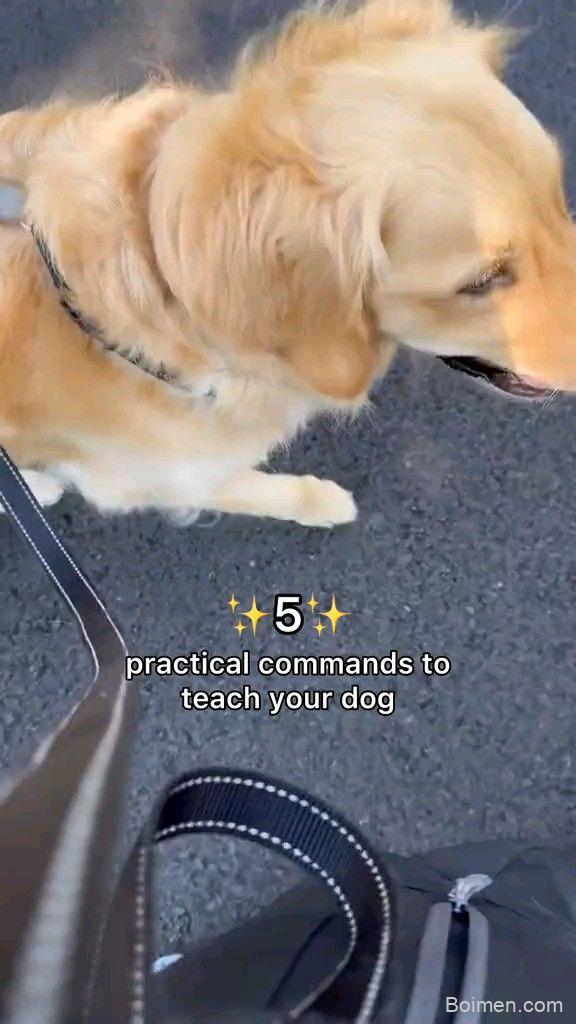
Most dogs don't fail training — the training fails the dog, usually because we taught a word instead of a behavior. Here are five genuinely useful commands, the exact order I teach them in, and the mistakes that turn a five-minute win into a six-month slog.
Advertisements1
- A command isn't learned until it works in three locations, at three distances, with three levels of distraction.
- Rewards must land within about one second — keep treats in your pocket, not across the room.
- Say each cue once; repeating it teaches your dog that words are background noise.
- Make "come" a jackpot and never scold a dog who returns, or you'll teach them to avoid you.
- Teach "place" to give your dog a job — a dog with a job is a calm dog.
- Practice in 3-minute bursts twice a day instead of one long weekend session.
Why Five Commands Beat Fifty Tricks
Picture your dog's brain as a kitchen drawer. You can cram it with thirty gadgets, or you can keep five tools you actually reach for. Professional trainers call this "stimulus control" — plain English: your dog responds to a cue every time, not just when the mood strikes. A dog who knows five commands cold is safer and easier to live with than one who half-knows twenty.
My rule of thumb: a command isn't "learned" until your dog nails it in three different rooms, at three distances, with three levels of distraction. That's 27 little tests. Sounds brutal? It's actually a checklist that stops you from declaring victory too early — the training equivalent of not calling a cake done because the timer beeped.
Order matters too. I teach the five below in this sequence because each one builds the focus the next one needs. Skip ahead and you'll be building a house starting from the roof.
The One-Second Rule That Changes Everything
Here's the difference between a command that sticks and one that evaporates: the reward has to land within about one second of the behavior. Dog memory for cause-and-effect is short and sharp, like a camera shutter — click, and the moment is captured. Wait three seconds and you've photographed something else entirely.
This is why I keep treats in a pocket, not a jar across the room. If you have to walk to the kitchen, you've already missed the window. Use tiny, high-value rewards — pea-sized bits of chicken or cheese, not a whole biscuit. Ten tiny rewards beat one big one, because you get ten chances to say "yes, that!"
And here's the playful part: a reward isn't always food. For some dogs, a thrown ball or a tug toy is a jackpot. Watch what your dog lunges for and use that. Training is a conversation, and you want to speak their favorite language.
Command 1: "Watch Me" — The Foundation Nobody Brags About
"Watch me" (or "look") means: make eye contact with me. Boring? Absolutely. Essential? Completely. It's the handshake that starts every other command — you can't ask a dog to sit if their attention is on a squirrel.
Technique: hold a treat at your nose, say "watch me" once, and the instant your dog's eyes meet yours, mark it with a clicker or a cheerful "yes!" and reward. Start with zero distractions in your living room. Then add a doorway, then the backyard, then a quiet street. Each new place is a fresh level, not a failure.
Common mistake: repeating "watch me, watch me, watch me" like a broken radio. Say it once. If your dog doesn't respond, you're too far ahead — make it easier. Repeating a cue teaches your dog that words are background noise, like a car alarm.
Command 2: "Sit" and "Stay" — Two Commands, One Skill
Sit is the easy part: lure a treat from your dog's nose up and back over their head, and gravity does the work. The real command is stay, and most people rush it. I build duration in five-second increments — five seconds, then ten, then fifteen — and only add distance once duration is rock solid at your side.
Think of stay like a parking brake. You don't test it on a hill on day one; you test it on flat ground first. So: dog sits, you count to five, reward, release with a clear "okay!" or "free." The release word matters — without it, your dog decides when stay ends, and you've taught "stay until I feel like moving."
Pro tip from years of doing this: practice stay during commercial breaks, not marathon sessions. Three reps of five seconds, twice a day, beats one 20-minute session every Sunday. Dogs learn in small, frequent sips, like checking your phone — little and often.
Command 3: "Come" — The Command That Saves Lives
Recall is the command people most want and most accidentally ruin. The classic mistake: yelling "come!" when your dog is doing something they love, then leaving or ending the fun. Congratulations — you've just taught your dog that "come" means "party's over."
Instead, make "come" a jackpot. Say it once, in a happy voice, then reward generously — a handful of treats, one at a time, or a game of tug. Then release your dog back to whatever they were doing. Over time, "come" becomes a promise of good things, not a threat.
Practice on a long line (a 15-foot leash) before you ever trust recall off-leash. And never, ever scold a dog who comes to you, even if they took their sweet time. A dog who arrives to a scolding learns one lesson: don't arrive. That's the opposite of what you want, like punishing a friend for finally returning your call.
Command 4: "Leave It" — The Polite Ignore
"Leave it" means: stop paying attention to that thing. It's the command that keeps your dog from eating a chicken bone on the sidewalk, so it's worth teaching properly. Start with a treat under your shoe — low value, easy to ignore — and reward your dog for looking at you instead.
Here's the sequence I use: show the treat, cover it with your foot, say "leave it" once, wait for your dog to back off or look up, then mark and reward with a different, better treat from your other hand. The lesson: ignoring the thing on the ground earns something better from you. That's a trade, not a punishment.
Common mistake: using "leave it" for everything, including things your dog is allowed to have. Keep the cue specific to "not yours." If your dog can't tell the difference between a forbidden shoe and a permitted chew toy, you've created confusion, not clarity.
Command 5: "Place" — The Off-Switch for Busy Homes
"Place" means: go to your mat or bed and settle there. It's the closest thing to an off-switch for a dog, and it's a lifesaver when guests arrive or dinner is on the table. I teach it by tossing a treat onto the mat, marking when all four paws land there, and rewarding calm.
Build it in layers: first, your dog goes to the mat and gets rewarded. Then they stay for five seconds. Then fifteen. Then you take one step away. Each layer is a small, winnable step — like leveling up in a game, not jumping straight to the boss fight.
The magic is that "place" gives your dog a job. A dog with a job is a calm dog. Instead of pacing and barking at the doorbell, they have a clear instruction: mat, settle, wait. That's not obedience for its own sake — it's giving your dog a way to succeed in a human world.
How to Do It, Step by Step
- 1Pick one command and one location
Choose a single command from the five and practice it in one quiet room. Why: dogs generalize poorly, so one room keeps the picture simple and sets you up for success. - 2Load your rewards before you start
Measure out 10–15 pea-sized treats and keep them in your pocket. Why: rewards must land within one second, and a jar across the room guarantees you'll miss the window. - 3Say the cue exactly once
Give the word one time, then wait. If your dog doesn't respond, make it easier rather than repeating. Why: repetition teaches your dog that cues are optional. - 4Mark and reward the instant it happens
Use a clicker or a crisp "yes!" the moment the behavior occurs, then treat. Why: the marker bridges the gap between behavior and reward, like a camera shutter freezing the right moment. - 5Add one distraction per session
Once your dog is reliable, add a doorway, a toy on the floor, or a second person. Why: each new distraction is a level-up, and stacking them too fast causes regression. - 6Practice in 3-minute bursts, twice daily
Set a timer for three minutes and stop while your dog is still winning. Why: short, frequent sessions beat long ones, and ending on success keeps training fun. - 7Proof it in three places before calling it learned
Test the command in three rooms, at three distances, with three distractions. Why: a command only counts when it works everywhere, not just where you taught it.
A command isn't learned until it survives a squirrel, a doorway, and a guest — train for the real world, not the living room.
Frequently Asked Questions
What is the easiest command to teach a dog first?
"Watch me" is the easiest and most useful first command because it builds the attention every other cue depends on. Hold a treat at your nose, say it once, and reward the instant your dog makes eye contact.
How long does it take to teach a dog a new command?
Most dogs can learn a basic command in a few short sessions over one to two weeks, but reliability in distracting places takes longer. Expect roughly 27 small tests — three locations, three distances, three distractions — before calling it solid.
Should I use a clicker or a verbal marker?
Either works, as long as you use it consistently and reward within one second. A clicker is more precise, while a cheerful "yes!" is always with you — pick one and stick with it.
Why does my dog ignore the "come" command?
Usually because "come" has been paired with something unpleasant, like ending playtime or being scolded. Rebuild it by saying it once, rewarding generously, and releasing your dog back to the fun.
How many treats should I use per training session?
Plan for 10–15 pea-sized, high-value treats per 3-minute session. Small and frequent rewards give you more chances to mark the right behavior than one large biscuit.

Kwame writes about technology and digital privacy for everyday users. He breaks down complex topics like data tracking and encryption into simple, relatable terms.


Leave a Comment