
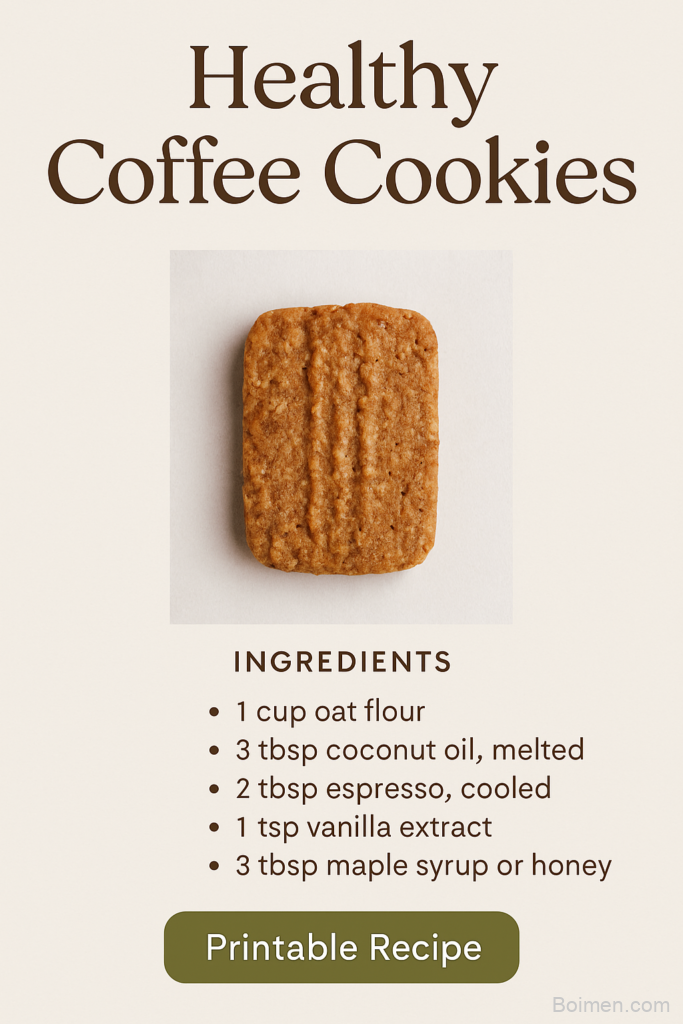
Healthy Coffee Cookies are what happens when you treat a cookie like a small, well-built machine: oat flour for structure and fiber, coconut oil for fat without palm oil, and a real espresso shot for flavor instead of a whisper of instant powder. One cookie lands at roughly 285 calories with 12g protein and 22g carbs, which is a defensible snack, not a dessert you have to apologize for.
Advertisements1
Here is the math that matters. Oat flour absorbs more liquid than wheat flour, so this dough uses 2 large eggs plus 60ml brewed espresso to hit the right hydration. Get that ratio wrong and you get either a crumbly puck or a flat pancake. I tested this at 350F (175C) for 12 minutes per tray, and the window between chewy and dry is about 90 seconds, so read the doneness cue below carefully.
No palm oil, no refined white flour, no stand mixer required. You need one bowl, one whisk, and a baking sheet. Total time is 50 minutes, most of it waiting for the oven. Stay sharp, stay solvent.
Why You'll Love This Recipe
About the Ingredients
1 3/4 cups (175g) oat flour, spooned and leveled
Use certified gluten-free oat flour if celiac is a concern, since oats are often cross-contaminated. Buying tip: grind rolled oats in a blender for 45 seconds if you cannot find oat flour, then sift out the coarse bits.
1/2 cup (100g) coconut sugar
Coconut sugar has a faint caramel note that pairs well with coffee and measures 1:1 for white sugar. Substitution: light brown sugar works identically; do not use liquid sweeteners or the dough will spread too far.
1/3 cup (70g) virgin coconut oil, melted and cooled to room temperature
Melt it, then let it sit 5 minutes so it does not cook the eggs. Substitution: unsalted butter, melted and cooled, gives a crisper edge; avocado oil gives a softer, cakier crumb.
2 large eggs (100g total, weighed out of shell)
Eggs are the only binder here, so do not reduce them. Substitution: 2 flax eggs (2 tbsp ground flax + 6 tbsp water, rested 10 minutes) work but add 8 minutes of bake time and a nuttier taste.
60ml (1/4 cup) strong brewed espresso or very strong coffee, cooled
Brew it double-strength; weak coffee disappears behind the sugar. Substitution: 2 tsp instant espresso powder dissolved in 60ml hot water is a fine backup. Buying tip: freeze leftover espresso in ice cube trays for the next batch.
1 tbsp (5g) fine coffee grounds
Fine grounds add texture and a second layer of coffee flavor. Substitution: skip them and add 1 tsp vanilla extract instead if you dislike any grit.
1 1/2 tsp baking powder
Check the date; baking powder older than 6 months loses roughly half its lift. Substitution: 1 1/2 tsp baking soda plus 1 tsp lemon juice, added at the last second.
1/2 tsp fine sea salt
Salt is what keeps the coffee from tasting flat. Substitution: 3/4 tsp kosher salt if that is what you have; do not use flaky finishing salt in the dough.
1/3 cup (50g) dark chocolate chips or chopped 70% chocolate
Chop a bar for bigger, uneven shards that melt into pools. Substitution: cacao nibs for less sugar, or toasted chopped walnuts for crunch.
1 tsp vanilla extract
Vanilla rounds off the coffee's acidity. Substitution: 1/2 tsp almond extract for a sharper, amaretto-adjacent profile.
Tips & Tricks
Measure the espresso, do not eyeball it
An extra 20ml of liquid makes these cookies spread 2cm wider and thin out. Use a measuring cup or a scale.
- Do not scoop oat flour straight from the bag: Oat flour compacts hard, and a packed cup can weigh 140g instead of 105g. Spoon it into the cup, then level with a knife, or weigh it.
- Cool the melted coconut oil before it meets the eggs: Oil hotter than 140F (60C) will partially scramble the eggs and leave flecks in your dough. Five minutes on the counter is enough.
- Pull the cookies 60 seconds before they look done: They should be set at the edge and slightly soft in the center. They firm up on the hot tray; an extra 90 seconds in the oven turns chewy into sandy.
Pro Tips
Step-by-Step Instructions
1. Heat the oven and line trays
Preheat the oven to 350F (175C) with a rack in the middle position. Line two baking sheets with parchment paper; do not use bare aluminum, since coconut oil cookies stick and brown too fast.
2. Whisk the wet base
In a large bowl, whisk 2 eggs, 1/3 cup melted coconut oil, 60ml cooled espresso, 1 tsp vanilla, and 1/2 cup coconut sugar for 45 seconds until the sugar dissolves and the surface looks glossy.
3. Combine the dry ingredients
In a second bowl, whisk 1 3/4 cups oat flour, 1 1/2 tsp baking powder, 1/2 tsp salt, and 1 tbsp fine coffee grounds until no clumps remain. Break up any oat flour lumps with your fingers.
4. Fold the dough together
Pour the dry mix into the wet bowl and fold with a spatula just until no dry streaks remain, about 20 strokes. Fold in 1/3 cup chocolate chips. Stop mixing when it looks uniform; overmixing makes the cookies tough.
5. Rest the dough 10 minutes
Let the dough sit at room temperature for 10 minutes so the oat flour absorbs the espresso. It should thicken from a wet batter to a scoopable, slightly tacky dough.
6. Scoop and shape
Scoop 2-tablespoon portions (about 45g each) onto the lined sheets, 12 cookies total, spaced 5cm apart. Flatten each ball to 1.5cm thick with the back of a wet spoon.
7. Bake 12 minutes at 350F (175C)
Bake one tray at a time for 12 minutes. Doneness cue: the edges are set and lightly golden brown, the centers look soft and slightly underdone, and the surface no longer shines. An instant-read thermometer in the center should read 200-205F (93-96C).
8. Cool on the tray 10 minutes
Leave the cookies on the hot tray for 10 minutes; they finish setting as they cool. Moving them immediately will tear the soft centers. Then transfer to a wire rack.
Delicious Variations
Mocha Almond Version
Swap the chocolate chips for 1/3 cup toasted sliced almonds and add 1/2 tsp almond extract. Bake time stays at 12 minutes.
Double Chocolate Espresso
Reduce oat flour to 1 1/2 cups, add 3 tbsp cocoa powder, and increase espresso to 75ml. These spread less and taste like a brownie edge.
Vegan Flax Version
Use 2 flax eggs and coconut sugar as written, then bake 18-20 minutes at 350F (175C) until the centers read 205F (96C). Texture is denser but still chewy.
How to Store Healthy Coffee Cookies (No Palm Oil – Oat Flour – Easy Recipe)
Refrigerator
Store in an airtight container at room temperature for 3 days, or refrigerate for up to 7 days. Refrigerated cookies firm up; bring them to room temperature for 15 minutes before eating.
Freezer
Freeze baked cookies in a single layer for 1 hour, then transfer to a freezer bag for up to 2 months. You can also freeze raw scooped dough balls for 2 months and bake from frozen at 350F (175C) for 15 minutes.
Reheating
Warm in a 300F (150C) oven for 4 minutes, or microwave one cookie for 10-12 seconds. Do not microwave longer than 15 seconds or the chocolate scorches and the crumb turns rubbery.
Frequently Asked Questions
Q: Can I make these coffee cookies without oat flour?
Yes, but you must adjust the liquid. Replace the oat flour with 1 1/2 cups all-purpose flour and reduce the espresso to 45ml, because wheat flour absorbs less liquid than oat flour. The cookies will be slightly less chewy and lose about 2g of fiber per serving.
Q: Are these cookies actually healthy?
They are healthier than a standard cookie, not a health food. Each cookie has about 285 calories, 12g protein, and 9g fat, with no palm oil and no refined white flour. Portion control still matters: two cookies is a 570-calorie snack.
Q: Why did my oat flour cookies turn out dry and crumbly?
You almost certainly packed the oat flour or overbaked by 2 minutes. Oat flour compacts to 140g per cup if scooped, versus 105g when spooned and leveled, and that extra 35g of flour dries the dough out completely.
Q: Can I use instant coffee instead of brewed espresso?
Yes, dissolve 2 teaspoons of instant espresso powder in 60ml of hot water and cool it before use. Do not substitute dry powder directly, because the dough needs that 60ml of liquid for hydration and structure.
Q: How do I know when these cookies are done?
The edges should be set and lightly golden while the centers still look soft and matte, at 12 minutes at 350F (175C). If you want a number, an instant-read thermometer in the center should read 200-205F (93-96C).
Mix one batch this week and track two numbers: your oven's true bake time and the weight of your oat flour. Those two data points will improve every oat-flour recipe you make from here on. If you bake these, leave a comment with your exact bake time and oven model. Stay sharp, stay solvent.

Healthy Coffee Cookies (No Palm Oil – Oat Flour – Easy Recipe)
Healthy Coffee Cookies made with oat flour and no palm oil: chewy, coffee-forward, and ready in 50 minutes with 6g protein per cookie.
🧂 Ingredients
- 1 3/4 cups (175g) oat flour, spooned and leveled
- 1/2 cup (100g) coconut sugar
- 1/3 cup (70g) virgin coconut oil, melted and cooled to room temperature
- 2 large eggs (100g total, weighed out of shell)
- 60ml (1/4 cup) strong brewed espresso or very strong coffee, cooled
- 1 tbsp (5g) fine coffee grounds
- 1 1/2 tsp baking powder
- 1/2 tsp fine sea salt
- 1/3 cup (50g) dark chocolate chips or chopped 70% chocolate
- 1 tsp vanilla extract
📋 Instructions
- 1Heat the oven and line trays — Preheat the oven to 350F (175C) with a rack in the middle position. Line two baking sheets with parchment paper; do not use bare aluminum, since coconut oil cookies stick and brown too fast.
- 2Whisk the wet base — In a large bowl, whisk 2 eggs, 1/3 cup melted coconut oil, 60ml cooled espresso, 1 tsp vanilla, and 1/2 cup coconut sugar for 45 seconds until the sugar dissolves and the surface looks glossy.
- 3Combine the dry ingredients — In a second bowl, whisk 1 3/4 cups oat flour, 1 1/2 tsp baking powder, 1/2 tsp salt, and 1 tbsp fine coffee grounds until no clumps remain. Break up any oat flour lumps with your fingers.
- 4Fold the dough together — Pour the dry mix into the wet bowl and fold with a spatula just until no dry streaks remain, about 20 strokes. Fold in 1/3 cup chocolate chips. Stop mixing when it looks uniform; overmixing makes the cookies tough.
- 5Rest the dough 10 minutes — Let the dough sit at room temperature for 10 minutes so the oat flour absorbs the espresso. It should thicken from a wet batter to a scoopable, slightly tacky dough.
- 6Scoop and shape — Scoop 2-tablespoon portions (about 45g each) onto the lined sheets, 12 cookies total, spaced 5cm apart. Flatten each ball to 1.5cm thick with the back of a wet spoon.
- 7Bake 12 minutes at 350F (175C) — Bake one tray at a time for 12 minutes. Doneness cue: the edges are set and lightly golden brown, the centers look soft and slightly underdone, and the surface no longer shines. An instant-read thermometer in the center should read 200-205F (93-96C).
- 8Cool on the tray 10 minutes — Leave the cookies on the hot tray for 10 minutes; they finish setting as they cool. Moving them immediately will tear the soft centers. Then transfer to a wire rack.

Diego covers personal finance and investing for freelancers and gig workers. His angle is practical money management for irregular income, from budgeting to tax basics.


Leave a Comment